

Psychological Safety Grows Up

One of the most useful—yet frequently misunderstood—ideas in team development is psychological safety, a term popularized by Amy Edmondson. Many leaders assume it’s binary: either a team has it, or it doesn’t. But like most aspects of leadership and culture, psychological safety is more nuanced.
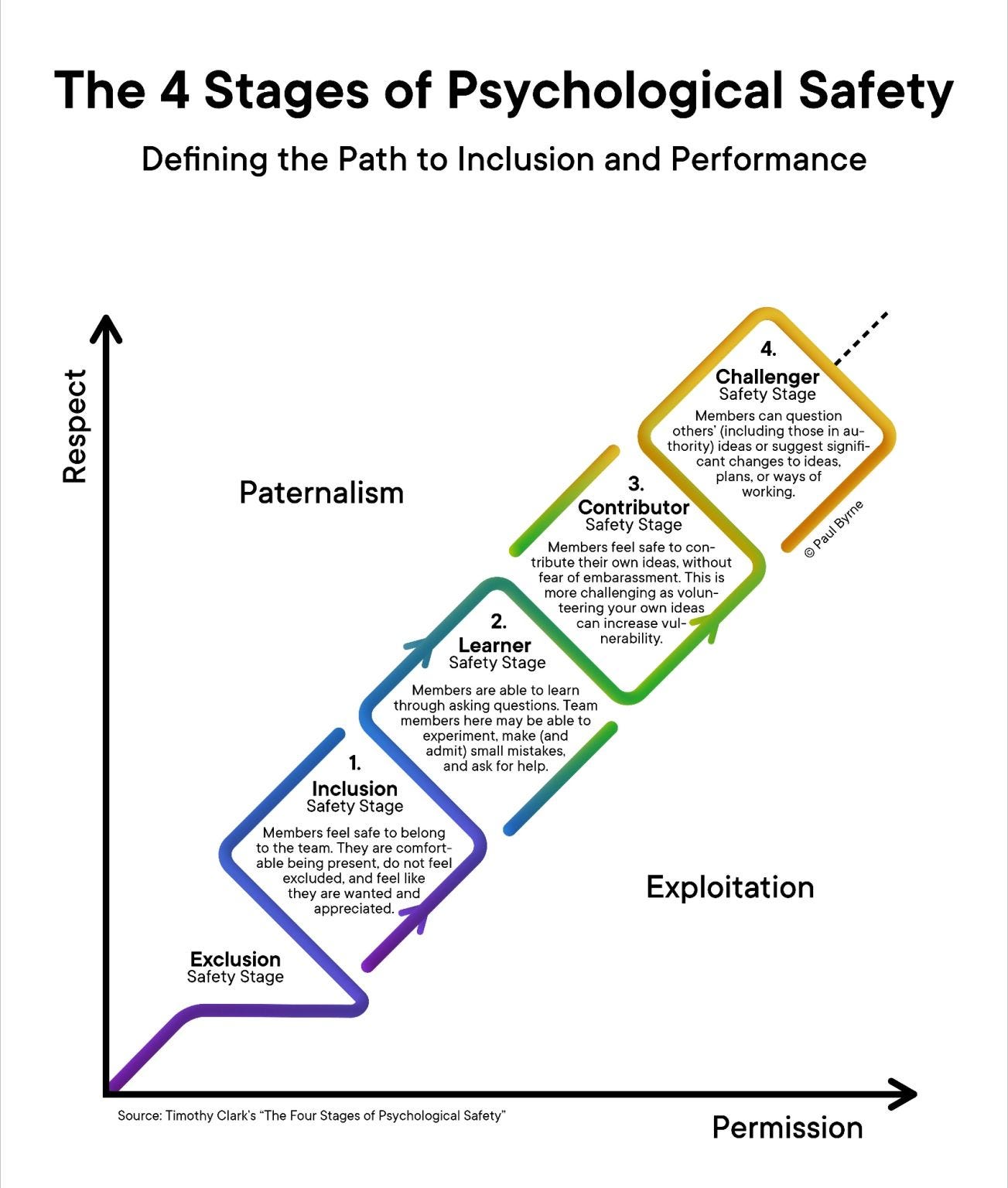
A helpful evolution of Edmondson’s work comes from Timothy R. Clark, who introduced the concept of the four stages of psychological safety in his book, The 4 Stages of Psychological Safety: Defining the Path to Inclusion and Innovation.
Clark’s central insight is that psychological safety matures in stages. It’s not a light switch—it’s a developmental journey.
Stage 1: Inclusion Safety – The foundation. Do I feel like I belong here? Am I accepted for who I am?
Stage 2: Learner Safety – Am I safe to ask questions, experiment, and make mistakes without fear of embarrassment?
Stage 3: Contributor Safety – Do I feel confident and supported in applying my skills and offering my perspective?
Stage 4: Challenger Safety – Can I challenge the status quo, speak truth to power, and offer dissent without fear of backlash?
Each stage builds on the one before it. You can’t skip steps. And while teams may move fluidly between stages depending on the context or topic, most have a default setting—the stage they tend to operate from most of the time.
Rather than asking “Do we have psychological safety?”, a more revealing question is: What stage are we at—and what would it take to grow into the next one?
Here’s a simple exercise you can try:
Draw Clark’s four stages on a whiteboard or slide. Ask each team member to place a tick mark at the stage where they believe the team operates most of the time. Don’t overthink it—just go with your gut.
Then reflect together:
Where do most of the ticks land?
Is there wide variation?
What might explain the differences?
What would be possible if we moved into the next stage?
What beliefs, behaviors, or norms would we need to let go of—or lean into—to get there?
Psychological safety isn’t just a climate issue—it’s a cultural capability. And like any form of maturity, it evolves through intentional practice, reflection, and shared commitment.
The question isn’t whether your team has psychological safety.
The question is: How far has it grown?