

Rethinking Accountability

Nearly every organization I work with these days is focused on building some version of a high-performance culture. It’s the dominant theme—an emphasis on speed, clarity, efficiency, and, inevitably, accountability.
But here’s the catch: most organizations treat accountability as a binary trait. You either have it, or you don’t. You’re either accountable, or you’re not.
That framing is far too simplistic.
In reality, accountability lives on a spectrum. It’s something we grow into—and sometimes fall out of—based on context, capacity, and mindset. To build cultures that genuinely perform at a high level, we need to understand accountability as a developmental process, not a fixed label.
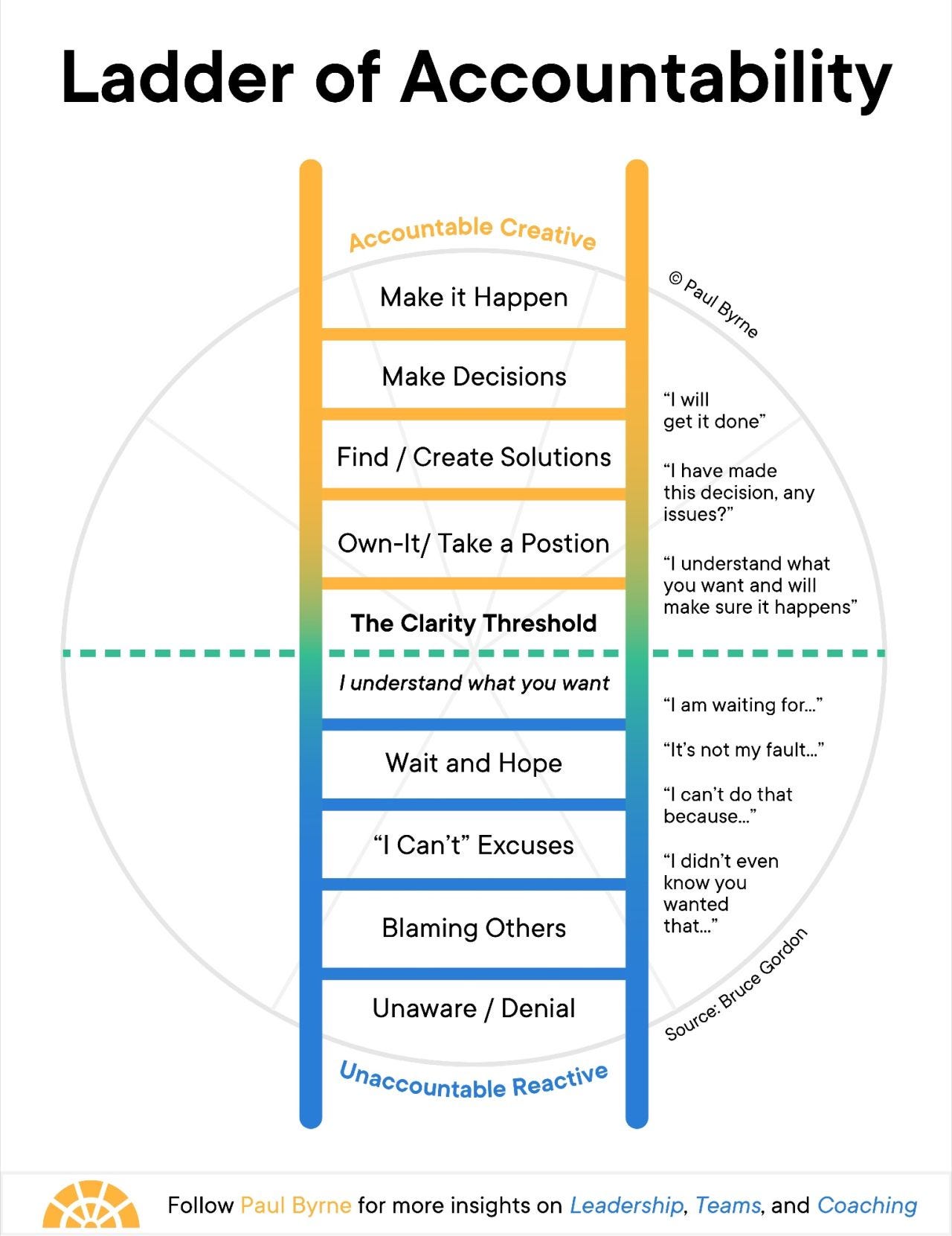
One of the most useful tools I’ve seen for exploring this idea is the Accountability Ladder. It outlines the different levels of engagement people have with a problem or responsibility—from denial and blame to ownership and inspiration. It’s especially helpful when paired with the Leadership Circle Profile, where we often see accountability evolve as leaders move from Reactive to Creative operating systems—from externalizing problems to internalizing agency.
Here’s a look at the ladder:
Unaware
Individuals are not aware of the issue. They simply don’t see it.Blaming Others
They see the problem but externalize responsibility: It’s not my fault.Excuses
The problem is acknowledged, but rationalized away: There’s nothing I can do.Wait and Hope
There’s recognition but passivity: Maybe someone else will fix it.Acknowledge Reality
This is the turning point. The person sees the truth and their role in it, but hasn’t yet taken meaningful steps.Own It
Ownership begins. They accept responsibility, even if they don’t yet know the full solution.Find Solutions
Active engagement begins. They explore possibilities and look for a path forward.Take Action
Ideas are put into motion. There’s momentum and movement.Make It Happen
There’s follow-through. They monitor progress, adjust as needed, and stay with it until the job is done.Inspire Others
The final step. Their behavior becomes contagious—they model and cultivate accountability in others.
A simple exercise
In leadership sessions, I often write this ladder on a flipchart or whiteboard and pose three questions:
What level of accountability do we see across the organization?
What level do we exhibit as a team—to one another and to our stakeholders?
Where would you place yourself right now, on a real issue you’re facing?
The conversation that follows is usually honest, revealing, and deeply useful.
The invitation
When we treat accountability as fixed, we shame those who fall short and fail to develop those who are ready to grow. But when we see it as a spectrum, we create the space for honest reflection, team learning, and—most importantly—upward movement.
What would shift if we stopped asking “Who’s accountable?”
And started asking “Where are we on the ladder—and what would help us climb?”