

What are your hidden loyalties?

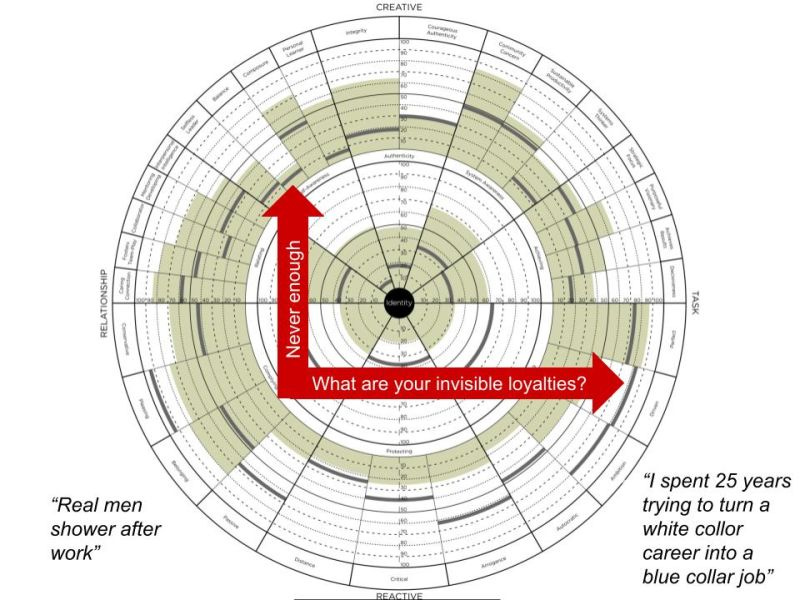
One of the areas I often explore when debriefing a Leadership Circle Profile is how hidden loyalties show up in a leader’s story.
We all carry loyalties—some conscious, many unconscious.
To our families of origin.
To the communities we grew up in.
To belief systems, cultures, and identities that shaped us.
Even to people we’ve never met.
These loyalties can be beautiful. They can ground us, guide us, and keep us connected to something larger than ourselves.
But when overextended, they can also hold us back—constraining our identity and limiting our impact.
The profile below is from a senior leader who had all the hallmarks of success.
Deep care for his team. Strong relationships. A powerful vision.
But also an exhausting pattern of overwork, perfectionism, and relentless self-criticism—directed almost entirely inward.
When we talked, he shared his story:
He came from a long line of blue-collar workers.
Men who made a living with their hands in the factories and mills that encircled his hometown.
He was the first in his family to go to university. The only one of his friends to leave town.
His intellect had given him a different path—but not without conflict.
There was an unspoken code in his family, captured in a line from Springsteen’s The River:
“I come from down in the valley,
Where, mister, when you’re young
They bring you up to do like your daddy done.”
He recalled a saying his father and uncles repeated:
“There are two kinds of people in the world—those who shower before work, and those who shower after.”
The message was clear:
Real work is physical, exhausting, and hard-earned.
To do anything else was to risk dishonor.
To be anything different was to risk disloyalty.
So he spent decades trying to make executive leadership feel like mill work.
He needed it to be difficult.
He needed to come home drained.
He needed to earn his place at the table the only way he knew how: through struggle.
Our ancestry can be a source of deep wisdom and strength.
But sometimes, the old stories we inherit need to be updated.
Loyalty is powerful. But it should never come at the cost of your wholeness.
So let me ask:
– What hidden loyalties might be shaping your leadership?
– Where might you be overextending them?
– And what new relationship with your past might free you to lead with more ease and integrity?
(Profile based on an actual leader, edited to ensure confidentiality.)